
The lessons scaling DemetrIA to SaaS reflect a massive operational shift: today, the platform manages more than 140,000 agricultural holdings and 140,000 operations across seven integrated data sources. Yet, it all started as a focused tool designed to do just one job well.
Start with one job, done properly
Demetria began life as Demetra, a functional tool built for agricultural technicians. It was designed to make a specific, recurring piece of work easier for the people who did it every day.
That turned out to be the right foundation. A narrow tool that people genuinely rely on earns something no roadmap can buy: trust in the field. When the time came to grow, there were real users, real workflows and real data to build on.
Field lessons scaling DemetrIA to SaaS by listening where the work happens
Agriculture is full of rules. CUE requirements, CAP management, treatment records and technical advisory all come with obligations, deadlines and formats. None of that is obvious from a meeting room.
We worked side by side with agricultural technicians and experts to understand how that work was actually done, where it broke and what it cost them. Each conversation became a concrete product decision that reduced the effort needed to comply.
Every conversation with a technician became a product decision.
Design for two very different users
A farmer standing in a field and a technician managing dozens of holdings need very different things from the same data. Each of them needs an interface built around their own work.
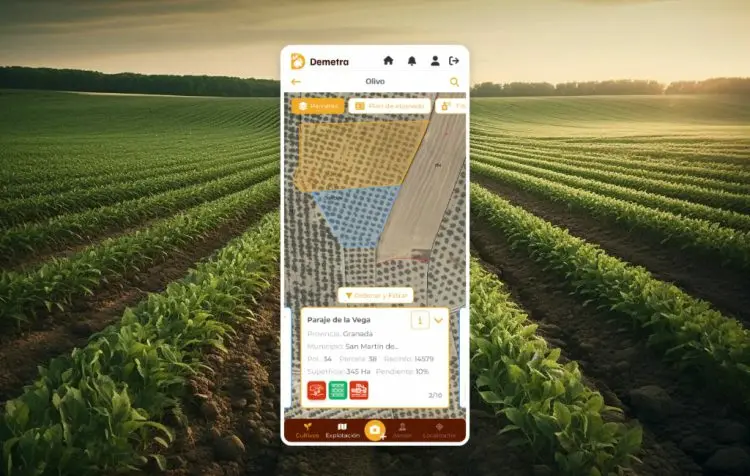
So Demetria offers two experiences on one platform. Farmers use a mobile app to send documents with photos, check their plots and register machinery. Technicians, cooperatives and financial institutions use a desktop platform built for review, management and decision-making. Underneath, both share the same data model, so information captured in the field is immediately useful in the office.
Treat integration as the product
As the platform grew, it became clear that much of its value came from its connections to other systems. Demetria brings together seven information sources, using APIs, GIS and secure integration with a centralised European data system, including the connection with SIEX–REA.
For users, the result is simple: one reliable view of all their information. For engineering, it meant treating integrations as first-class features, with the same care for reliability, error handling and traceability as any user-facing function. When an integration fails silently, users stop trusting the whole platform.
Applied AI lessons scaling DemetrIA to SaaS only where intelligence removes real work
AI is now part of Demetria, through contextual recommendations for farmers and technicians and through document digitisation. But it arrived late, and deliberately so.
Recommendations are only as good as the data behind them, and digitisation is only useful if it feeds a process people already follow. By the time AI was introduced, the data was structured, the workflows were stable and the value was easy to see: less typing, fewer errors and better-informed decisions.
Grow in short iterations, with the client in the loop
The move from tool to platform happened gradually, through short iterations, direct contact between the client and the development team, and a roadmap that could change as needs evolved.
The partnership itself was a big part of that. Demetra Agrodigital brought deep agronomic expertise; we brought the engineering. The platform reflects both.
What these lessons scaling DemetrIA to SaaS mean if you are building a platform
- Earn the right to grow. Solve one recurring problem well before designing for every user.
- Go where the work is. The most useful requirements come from the people doing the job.
- Separate experiences, share the data. Different users get their own interfaces on top of one shared model of the truth.
- Engineer integrations like features. They are often where most of the value, and most of the risk, lives.
- Add AI last. Introduce it once the data and workflows can support it.
Demetria was presented publicly at Expoliva 2025. It is still evolving, which is exactly what a platform should do.